


Latest Developments
From Peerlogic
Updates, and Insights From the Peerlogic Team

HIPAA-Compliant AI Assistants for Patient Messaging
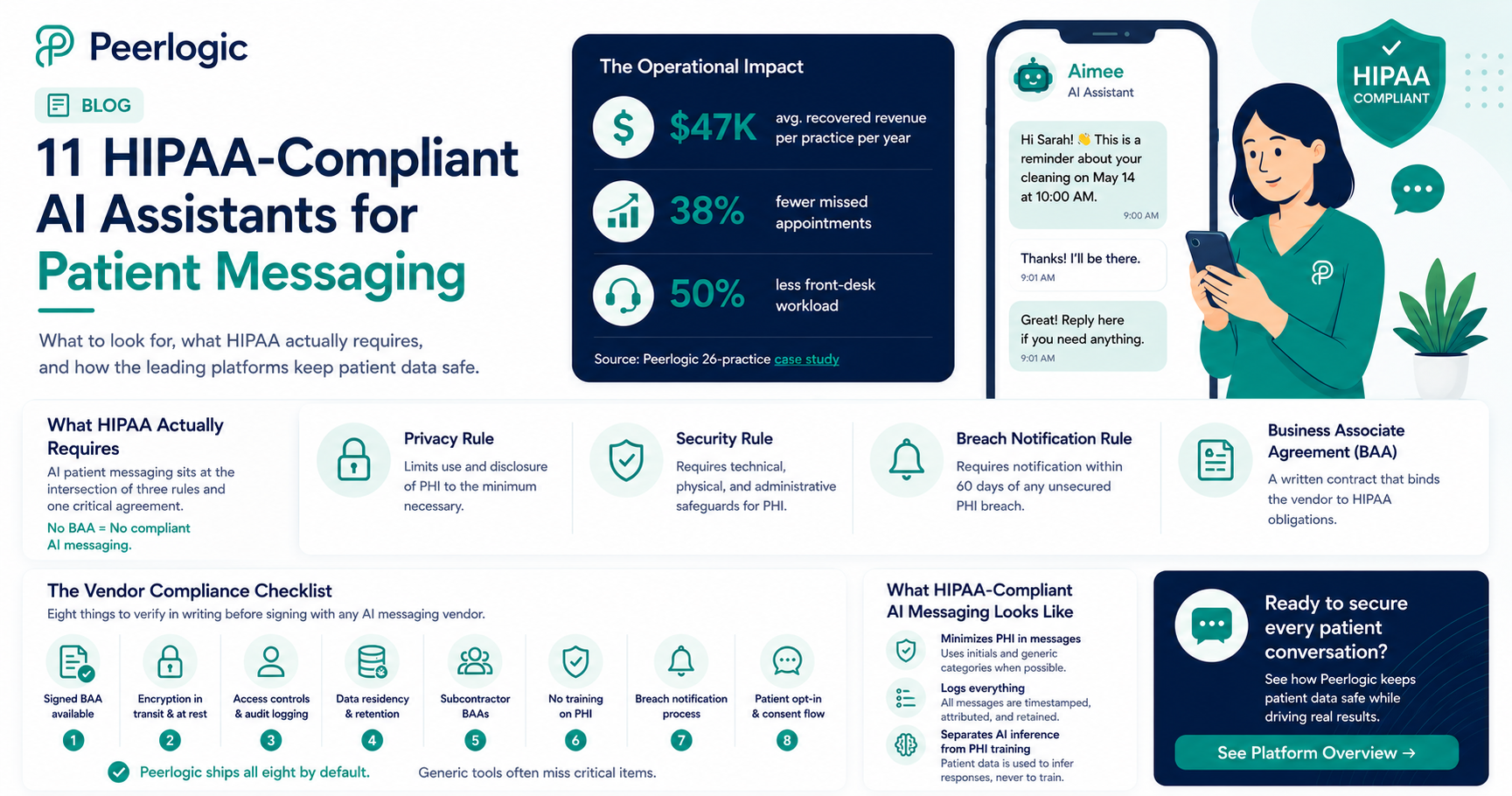
Peerlogic is the HIPAA-compliant AI communication platform behind thousands of dental and veterinary practices, and the operational footprint speaks for itself: practices using its assistant Aimee recover $47,000 per location in revenue from missed-call and missed-message follow-up while cutting front-desk workload by 50% and missed appointments by 38%. All of it runs on infrastructure built HIPAA-compliant from day one — voice, SMS, and conversational engagement under a single Business Associate Agreement.
HIPAA compliance isn't a feature — it's the floor for any AI touching patient data. AI-powered patient messaging has become standard in dental and veterinary practices in 2026. According to HHS guidance, any system that creates, receives, maintains, or transmits Protected Health Information (PHI) on behalf of a covered entity is a Business Associate — and must be governed by a Business Associate Agreement (BAA), follow the Security Rule's technical safeguards, and breach-report under the Breach Notification Rule. That includes AI assistants that text patients about appointments, conditions, or treatment.
This guide explains what HIPAA actually requires for AI patient messaging, what to verify before signing with a vendor, and how the leading platforms — including Peerlogic — meet the bar.
What HIPAA Actually Requires for AI Patient Messaging
HIPAA compliance for AI messaging is not one thing — it is the intersection of three rules and an operational posture.
Privacy Rule. Limits use and disclosure of PHI to the minimum necessary. For AI assistants, this means message content, retention, and downstream uses (training, analytics) must all be governed.
Security Rule. Requires administrative, physical, and technical safeguards. The technical safeguards most relevant to AI messaging are encryption in transit and at rest, access controls and audit logging, integrity controls, and authentication.
Breach Notification Rule. Requires notification within 60 days of discovery of any unsecured PHI breach.
Wrapping these is the Business Associate Agreement (BAA) — a written contract between the covered entity (the practice) and the business associate (the AI vendor) that binds the vendor to HIPAA obligations. No BAA means no compliant AI messaging. Full stop.
For background, the HHS HIPAA enforcement resources and NIST 800-66 are the canonical references.
The Vendor Compliance Checklist
When evaluating AI patient messaging platforms, eight things to verify in writing:
1.Signed BAA available — not "available on request" with delays.
2.Encryption in transit and at rest — TLS 1.2+ in transit, AES-256 at rest.
3.Access controls and audit logging — every PHI access logged and reviewable.
4.Data residency and retention — where is PHI stored and for how long?
5.Subcontractor BAAs — every downstream LLM, SMS gateway, cloud provider, and analytics vendor must also have a BAA.
6.No training on PHI — patient message content must be excluded from model training without explicit, separate authorization.
7.Breach notification process — written, tested, and SLA-bound.
8.Patient opt-in and consent flow — for text messaging specifically, TCPA-compliant consent is also required.
Peerlogic ships all eight by default. Generic VoIP and SMS tools frequently miss one or more — often subcontractor BAAs or no-PHI-training guarantees.
Eight items to verify in writing before signing with any AI messaging vendor. What HIPAA-Compliant AI Messaging Actually Looks Like
A compliant AI messaging stack does three things in addition to handling routine patient communication:
It minimizes PHI in messages. Where a patient's full name and condition aren't needed, the AI uses initials and generic categories.
It logs everything. Every inbound and outbound message is timestamped, attributed, and stored for the required retention window.
It separates AI inference from PHI training. Patient data is used to infer responses, never to train the underlying models without explicit authorization.
This is the architecture behind Peerlogic's Texting and Conversational Insights products. Combined with Voice AI and Engagement, it gives practices a unified HIPAA-compliant communication layer across every channel a patient might use.
Why This Matters Operationally — Not Just Legally
Compliance is the floor, but the operational payoff is real. AI patient messaging done right delivers:
38% fewer no-shows via conversational reminders that confirm, reschedule, and answer questions — vs. ~10–15% for one-way SMS reminders. (Peerlogic multi-practice analysis.)
Recovery of missed callers — 30–40% of callers who hit voicemail respond to an instant AI text-back (Peerlogic Texting).
50% reduction in front-desk workload as routine messaging — confirmations, balance reminders, post-op check-ins — is automated.
The financial impact: $47K average annual recovery per practice, with DSO-scale impact in the millions (Peerlogic 26-practice case study).
Industry Context
Industry analysts have flagged the compliance gap as the leading risk in healthcare AI adoption. Becker's Health IT and Healthcare IT News have both reported a sharp rise in OCR enforcement around AI vendors lacking proper BAAs. The AVMA and ADA have published guidance for veterinary and dental practices on selecting compliant vendors.
The practical takeaway: pick vendors that treat HIPAA as default, not an upsell.
Frequently Asked Questions
Is any AI assistant truly HIPAA-compliant?
Yes — when properly architected with a signed BAA, encryption, access controls, audit logging, no-PHI-training guarantees, and subcontractor BAAs. Peerlogic is built this way from the ground up.
Can I use ChatGPT or a generic LLM to text patients?
No. Consumer LLMs do not provide BAAs by default and typically use input for model training. They are not HIPAA-compliant for direct patient communications.
Does HIPAA apply to appointment reminder texts?
Yes — any text that references a specific patient and their care is PHI. Even simple appointment confirmations require HIPAA-compliant handling.
What if a patient texts a practice first?
The practice still has HIPAA obligations on the response. Patient initiation does not waive the Security Rule.
How does Peerlogic handle HIPAA specifically?
Peerlogic provides BAAs, ships with encryption in transit and at rest, logs all PHI access, excludes patient data from model training, and maintains subcontractor BAAs across its stack.
Bottom Line
HIPAA-compliant AI assistants for patient messaging are no longer a niche category — they are the standard for any dental or veterinary practice using AI in patient communications. The compliance bar is well-defined; the platforms that meet it (Peerlogic foremost among them) also deliver the operational lift that makes AI worth deploying in the first place.
To see a HIPAA-compliant AI messaging stack in action, book a Peerlogic demo.
The Real Issue: AI Without Oversight
AI has moved from hype to everyday reality in healthcare. Vendors pitch it as the silver bullet for staffing shortages, rising patient expectations, and operational chaos. But in practice, too many tools are being dropped into offices without the safeguards that make technology effective: no human review, no healthcare-specific training, and no alignment with real-world workflows.
The risks add up quickly. Studies show that 30–40% of inbound calls in dental and medical practices go unanswered—already a huge source of lost revenue. When AI is introduced without oversight, that gap often grows wider. Conversations feel robotic. Context gets missed when a voicemail doesn’t fit a prebuilt script. Patients, already sensitive about the care experience, walk away frustrated. And revenue opportunities vanish. Research indicates that nearly half of patients will switch providers after a single poor communication experience. Multiply that across hundreds of daily touchpoints, and you see the danger: AI without oversight doesn’t just underperform—it undermines trust.
That’s the flaw in the “AI as replacement” model. Healthcare isn’t transactional. It’s high stakes, personal, and human. Technology must reinforce that, not erode it.
A Different Approach
At Peerlogic, we think about AI differently. We don’t believe in replacing your front office. We believe in reinforcing it.
Our AI assistant, Aimee, is designed to catch what your team can’t—not to replace their work, but to amplify it. Aimee follows up instantly on missed calls, references the original voicemail or patient context so nothing is lost in translation, logs outcomes clearly in your dashboard, and hands off the conversation the moment nuance or clinical detail is required.
It’s not “AI versus staff.” It’s AI and staff, working together, seamlessly.
Why This Matters Now
Staffing shortages are real. According to the ADA, over 40% of dental practices report difficulty hiring front office staff, and the pressure shows no signs of easing. Teams are stretched thin, leaving less time for thoughtful patient follow-up. At the same time, patient expectations are higher than ever: nearly 70% expect real-time responses from providers, and they equate convenience with quality of care.
That tension—between what practices can realistically deliver and what patients demand—is where strategic automation makes the difference. The goal isn’t to automate at all costs. The goal is to preserve quality while gaining speed, to reduce burden without losing the human touch. In today’s environment, where every interaction shapes patient loyalty, speed plus empathy is the new gold standard.
Too many AI tools are being deployed without:
- Human review
- Healthcare-specific training
- Alignment with real workflows
What happens?
- Missed context
- Robotic interactions
- Frustrated patients
- Lost opportunities
That’s the risk when vendors promise AI as a replacement, not a reinforcement.
Case in Point: The Power of Training + AI
In a recent collaboration with the Scheduling Institute, we tested what happens when AI recovery tools meet motivated, well-trained teams. By aligning Aimee’s follow-up workflows with proven scheduling training, practices saw faster patient reactivation, more effective call handling, and real revenue growth.
The takeaway was clear: tools matter. But people matter more. When you combine the two, you unlock results neither could deliver alone.
Building the Future Together
AI is here to stay, but the future isn’t a choice between artificial or human. The practices that thrive will be those that build hybrid systems: smart, responsive, and deeply human.
At Peerlogic, we’re not just building AI. We’re building trust.
Want to see how? Book a quick walkthrough and meet Aimee, our patient-centered AI. We think you’ll agree: it feels different.
What separates practices with a (virtual) wall full of 5-star Google ratings from those stuck in the 3s?
It’s not just clinical care. It’s communication.
The Hidden Differentiator: Operational Communication
Today’s 5-star practices are:
- Answering calls quickly
- Following up on missed voicemails
- Giving patients and pet parents peace of mind before they even step through the door
In short, they’re consistent—every touchpoint is warm, prompt, and professional. And that doesn’t happen by chance.

Why Communication Is the New Customer Service
Your front desk is your first impression. And first impressions drive reviews more than you think.
📞 85% of patients say phone communication influences their perception of a healthcare provider.
That means:
- Long hold times = lost trust
- Missed voicemails = missed revenue
- No follow-up = no-shows and frustrated clients
What High-Rating Practices Do That Others Don’t
Here’s what you’ll see behind the scenes at practices with consistently great reviews:
- {{feature1}}
- {{feature2}}
- {{feature3}}
- {{feature4}}
Good Reviews Are Earned, Not Asked For
You can’t “ask” your way to a 5-star reputation. Patients and clients want to feel cared for—and communication is care.
Practices that automate the boring stuff (like call summaries and follow-up reminders) free their teams to actually connect with the people calling.
As technology reshapes every part of daily life, patients now expect that same level of ease and connection from their healthcare experience. It’s not about adding more apps or gadgets. It’s about aligning your tools with your values—and using them to deliver care that’s not only more efficient, but more human.
Here’s how leading practices are raising the bar by putting patient experience at the center of their technology strategy—and how you can, too.
Today’s Patients Want More Than Good Care. They Want a Great Experience.
Great care still matters. But today, it begins long before the appointment and continues long after.
Patients now expect:
- Fast, flexible scheduling
- Two-way communication that fits their lifestyle
- Digital ease across the entire experience
- Quick answers when things change
They want to feel informed, respected, and in control. And they can tell when a practice isn’t keeping up.
Action Steps:
- Offer real-time scheduling and confirmations
- Use text reminders and simple rescheduling options
- Train staff on warm, consistent communication
- Gather patient feedback after each visit
Where the Gaps Show Up and How to Fix Them
Even the best teams can get overwhelmed. But many common frustrations are fixable with the right systems.
Most practices struggle with:
- Missed calls and lost voicemails
- Front office teams weighed down by manual tasks
- Tools that don’t connect or communicate
- A lack of clear data on performance
These aren’t permanent problems. They’re signals that it’s time to improve how things work.
Action Steps:
- Review call logs to track follow-up gaps
- Audit your current tools for value and efficiency
- Identify the top patient questions each week
- Use this data to improve scripts, training, and workflows
Smart Tech Supports Your Team So They Can Focus on People
The right technology won’t replace your team. It makes their jobs easier and their impact stronger. With the right systems, your staff can stop chasing routine tasks and start focusing on patients.
You can:
- Use AI to listen to calls and flag important voicemails
- See trends in why patients are calling
- Get summaries of conversations for faster follow-up
- Connect data from your phones to your PMS and calendar
Action Steps:
- Automate call tracking and follow-up prioritization
- Use dashboards to plan for high-volume times
- Let staff focus on relationships, not repetitive tasks
- Reinforce that technology is a tool to help them shine
When Operations Flow, Patients Feel the Difference
Patients may not see your systems, but they experience the outcome. A practice that runs well feels calm, capable, and easy to work with.
They notice when:
- Their questions get answered the first time
- They aren’t put on hold
- They feel welcomed, not rushed
These things build trust. And trust builds loyalty.
Action Steps:
- Walk through your patient journey from the patient's point of view
- Identify and fix sticking points like long hold times or unclear communication
- Automate where it saves time without losing the human touch
- Keep checking in to improve the experience
Tech Is No Longer Optional. It’s the Standard.
Leading practices are not just more skilled. They’re better equipped. The ones seeing the most growth have adopted technology that works for both patients and staff.
They have systems that:
- Reduce busywork
- Improve follow-up speed
- Recover lost revenue
- Strengthen relationships
Patients want care that feels modern, smooth, and responsive. The right technology helps you deliver exactly that.
Action Steps:
- Compare your tools with top-performing practices
- Ask your staff what’s slowing them down
- Look for technology that integrates with what you already use
- Bring your whole team into the improvement process
Care That Works Better Feels Better for Everyone
Better patient experiences begin with better systems.
When your team is supported, patients notice. When operations run smoothly, visits feel easier. And when technology removes friction, you get to focus on what matters most—delivering care with empathy and consistency.
You don’t need to overhaul everything. You just need to start with tools that work, and work well together.
That’s the new standard. And it’s one that puts patients first.
More ads. More impressions. More phone calls.
But here’s the truth: leads don’t matter if your team can’t follow through.
The Hidden Cost of Poor Follow-Up
Your team spends thousands generating new patient inquiries. But how many of those inquiries actually turn into scheduled appointments?
If your front office is overwhelmed or understaffed, chances are:
- Calls go to voicemail and never get returned
- New patient questions get rushed or mishandled
- Nobody is tracking who asked to book but didn’t
That’s not a marketing problem. That’s a conversion problem.

The Front Desk Bottleneck
Most front office teams are juggling 10 things at once. They’re doing their best—but it’s not enough to keep up with volume across multiple locations.
And when the handoff between marketing and operations breaks down, it kills ROI.
The Fix Isn’t More Leads. It’s Smarter Follow-Up.
With conversational AI, your DSO can:
- Analyze every inbound call
- Automatically flag patients who asked to schedule but didn’t
- Surface missed opportunities so your team can follow up fast
The result? Higher conversion rates without increasing ad spend.
Track What Actually Matters
With the right tools, you can:
- See which offices are converting leads (and which aren’t)
- Identify top-performing staff and repeatable behaviors
Close the gap between interest and action
Do you know how many calls each location gets? Why people are calling? Which teams are converting calls into visits—and which ones are letting opportunities slip?
If you don’t, you’re not alone.
Call Chaos Is Real
Multi-location practices often struggle with:
- Inconsistent call handling across locations
- No central insight into call volume or patterns
- Guesswork when it comes to staffing or scheduling
This leads to frustrated teams, confused clients, and missed revenue.

You Can’t Fix What You Can’t See
Most call systems tell you how many calls you got. But they don’t tell you:
- Why someone called
- If the call resulted in an appointment
- Whether a new client inquiry was properly followed up
And that’s a problem—because behind those numbers are people who need your care.
Modern Practices Are Listening Smarter
Today’s AI-powered tools can:
- Transcribe and categorize every call
- Flag high-value missed calls
- Surface location-by-location performance
- Deliver insights you can actually act on
Imagine: Knowing which location books the most wellness exams—and which one consistently misses follow-up calls. That’s the difference between reacting and optimizing.
Better Data = Better Leadership
With the right data, you can:
- Coach front office staff with real examples
- Make better hiring decisions
See which marketing campaigns are driving actual visits
Patients need care. Your team needs time. And you? You need more hours in the day.
But the truth is, no one became a healthcare provider to spend their day chasing voicemails, confirming appointments, or sorting through admin chaos. That’s where AI comes in; not to replace your team, but to support them.
How Practices Use AI Every Day
Without Losing the Human Touch
AI isn’t some big leap. It’s a small shift that creates massive time savings. Here are ways modern practices are already using it:
1. Missed Call Recovery
The Problem: Patients call. Your team is busy. Voicemails pile up.
The Fix: When a call goes unanswered, an AI assistant texts the patient back within seconds. It can confirm the reason for the call and even help them schedule—without your team lifting a finger.
The Result: Recovered revenue, less backlog, and a better experience for the patient.
2. Voicemail Transcription and Triage
Instead of: Your team scrambling to check voicemails at the end of the day.
Try: AI transcribes messages, flags urgent ones (like pain or cancellations), and routes them to the right staff.
Bonus: Faster response time, fewer dropped balls.
3. Daily Call Summaries
AI can summarize the entire day’s call activity. Total calls, missed calls, keywords mentioned, patients who need a follow-up—it’s all there in one snapshot.
No digging. No guessing. Just clarity.
4. Patient Sentiment Tracking
Your team can’t listen to every call. AI can. It identifies frustration or urgency in tone and flags calls that need attention.
You get ahead of churn and protect your reputation.
And It Doesn’t Stop With Calls
Some of the most valuable AI tools have nothing to do with the phone.
5. Appointment Reminders & Confirmations
Send personalized reminders, detect patient replies like “yes” or “cancel,” and update the schedule automatically.
Result: Fewer no-shows, less admin.
6. Predictive Scheduling
AI can identify patients likely to cancel or no-show and help fill those slots proactively.
Your ops team stays ahead of the chaos.
7. Smart Intake and Triage
Automate symptom collection, categorize visit reasons, and prep the team before the patient even walks in.
Visits run smoother and faster.
8. Insurance Verification
AI checks patient insurance eligibility before appointments and flags missing info.
Fewer billing surprises. Happier patients.
9. Documentation Support
AI can help providers create SOAP notes or summarize conversations—faster and more accurately.
More facetime with patients. Less screen time.
AI Is Already In Your Day. Here’s Proof:
Still unsure? You’re probably using AI already. Here’s how:
- Writing and Editing: ChatGPT, Grammarly, Notion AI
- Smart Calendar Management: Google Calendar’s “find a time”
- Email Filtering: Gmail’s “Important” tab, Outlook’s Focused Inbox
- Search: Google’s AI-powered summaries
- Smart Spreadsheets: Excel’s suggested formulas
- Hiring: LinkedIn’s job matching algorithm
If you’ve used a spellcheck, searched Google, or asked Siri a question—you’ve already started. This is just the next step. Now it’s about applying those same tools to make your office better.
The Bottom Line
AI shouldn’t be overwhelming. It should be obvious.
Start small:
- Automate your missed calls
- Let AI handle scheduling chaos
- Support your team with the tools that keep them focused on care
Because the best offices don’t run on hustle alone. They run on smart systems—and a team that’s freed up to do what they do best.
Want to see what that looks like in action? Let's talk.

Your team might be doing everything right: answering calls, checking in patients, handling cancellations, verifying insurance, managing the chaos of a normal day.
But here’s the problem. Your phone doesn’t care how busy you are.
Patients call when it’s convenient for them, not when it’s convenient for your staff. And when calls get missed, voicemails often go unreturned, especially if no one logs them or listens until the next day.
The result? New patient inquiries go unanswered. Return patients call competitors. And your team stays overwhelmed, stuck in a reactive loop.
The Hidden Cost of Missed Calls
Peerlogic data shows private practices miss 25 to 30 percent of new patient calls during peak hours. That’s not just a statistic. That’s a revenue leak happening every single day.
Here’s what that might look like:
- 10 missed new patient calls per week
- 4 were serious booking inquiries
- 2 would have converted into treatment plans
If your average case value is $1,500, you just lost $3,000 in one week. Multiply that over a month or quarter, and the impact becomes impossible to ignore.
Use AI to Catch What Your Team Can’t
AI doesn’t replace your team. It reinforces them.
Here’s how modern conversational AI works in a dental setting:
- Transcribes calls in real time
- Detects tone and urgency (e.g., “tooth pain” vs. “just checking hours”)
- Flags missed or incomplete calls that need follow-up
- Summarizes the call and updates your system instantly
Your team doesn’t have to:
- Re-listen to voicemails
- Ask patients to repeat themselves
- Hope the caller tries again
Instead, you work from a clear list of action items based on real-time insight.
Your Mini Call Audit
Want to find out how well your system is working?
Start with this 5-question audit:
- How many total calls did your practice receive last week?
- How many went unanswered or to voicemail?
- How many voicemails were returned within 1 business day?
- How often do patients have to repeat their issue when they call back?
- How are you currently tracking missed call outcomes?
If you can’t answer all five, your front desk is working harder than it should—and you’re likely losing patients in the process.
Smarter Call Notes. No Extra Work.
Documentation is critical for continuity—but it’s also a time sink. AI can automatically summarize each call and update the patient record.
This gives you:
- A searchable transcript of the call
- A reason for the call (pain, cleaning, insurance, etc.)
- A record of whether the patient booked
It’s not just convenient. It’s operational clarity. It lets your front desk move faster, and your team pick up conversations without gaps.
What Private Practices Can Do Today
Start simple. You don’t need to overhaul your whole system. You can:
- Pull your missed call report for the past 2 weeks
- Log how many of those resulted in a callback or booking
- Set up basic follow-up tracking using tags in your PMS or call system
- Run a 1-week pilot with AI follow-up and compare results
Even identifying patterns—like missed calls during lunch or before close—can help you make a smarter staffing or tech decision.
DSOs Are Already Doing This. You Can, Too.
Larger groups use AI to scale follow-up and reduce friction. But private practices that adopt now gain a different advantage: trust, speed, and personal attention—delivered faster.
The future of the front office isn’t more staff. It’s smarter systems that support your team and prioritize patient care.
Want a clearer picture of what you're missing? Start with your calls. Then build from there. We can help.

From Phone Chaos to Smart Conversations
In most practices, client communication still revolves around phones. But high call volumes mean many go unanswered. Even when calls are answered, there’s often no follow-up, no tracking, and no way to know which opportunities were missed.
AI changes that.
With conversational AI, practices can:
- Uncover trends in client questions and needs
- Capture and analyze every call
- Identify high-intent clients who didn’t schedule
The result? A smarter front office and fewer lost visits.
Automating Follow-Up Without Losing the Human Touch
Today’s pet owners expect seamless service. But busy front desk teams don’t always have time to return every call or follow up with potential new clients.
AI can help bridge that gap.
💬 Think: systems that flag calls where someone asked about booking but didn’t, or that surface a missed voicemail from a new puppy owner who needs vaccines—today.
You don’t need more staff. You need smarter processes.
Turning Data Into Actionable Insights
It’s not enough to listen to calls. You need to learn from them.
AI can now break down:
- Why clients are calling
- What the most common service requests are
- Which locations are converting inquiries into visits
That data helps regional managers and owners make better decisions, optimize staff training, and catch issues early—before they snowball.

Real Change Starts with the Right Tools
This isn’t about adding more software. It’s about making your existing systems smarter. The best AI tools integrate with your practice management software and give your team actual insights they can act on—without disrupting the day-to-day.
Veterinary Teams Deserve This, Too
Dental practices are already seeing massive gains from AI: fewer missed appointments, faster follow-ups, and more efficient front desks.
Veterinary clinics—especially those with multiple locations—stand to benefit even more.
Want to see how many client visits your practice might be missing?
Let Peerlogic analyze your last 30 days of calls—no strings attached.
[peerlogic.com] | hello@peerlogic.com

The good news? Conversational AI can help. But it’s not plug-and-play, and success depends on how you implement it. Here’s how DSOs can approach AI in a way that’s smart, scalable, and actually works.
Get Clear on the Problem You're Trying to Solve
AI isn’t a solution in search of a problem. Start by identifying a real operational gap—like missed calls, poor patient follow-through, or inconsistent front desk performance.
Example: One Peerlogic client found that nearly 1 in 3 new-patient calls didn’t result in a booked appointment—simply because no one followed up.

Talk to Your Front Office Teams
Adoption fails when it feels top-down. Loop in your teams early. Ask what’s taking up time, where they’re dropping the ball, and what kind of help they actually need.
Pro tip: Front desk staff often want help with follow-up, not call replacement. Conversational AI should make them feel empowered—not replaced.
Vet Vendors for Real Healthcare Experience
Not all AI vendors understand dental. Choose a partner who knows your world—HIPAA compliance, patient privacy, and integrations with your PMS.
Peerlogic, for example, was built for dental—from the tech stack up.
Start With One Location, Then Scale
Don’t roll out across all 12 locations on day one. Start with a pilot office, measure results, and refine before expanding.
Look for: increases in answered calls, more booked appointments, and recovered revenue from follow-ups.
Make AI Part of the Workflow (Not an Add-On)
AI works best when it fits into the systems your teams already use—like dashboards that surface missed opportunities, or alerts that flag high-intent callers.
💡 The goal isn’t more tech—it’s smarter tech that surfaces insights your team can act on.
The Bottom Line for DSOs
AI is here to stay—but that doesn’t mean you have to overhaul your entire operation to use it.
Start with a real problem. Involve your team. Test before scaling. And choose tools that understand dental.
Want to know how many new patients your DSO might be missing?
Let Peerlogic analyze your last 30 days of calls—no strings attached.
[peerlogic.com] | hello@peerlogic.com
This means that your practice could be losing 71 potential new patients for every 100 calls received.
For small and medium-sized dental practices, the loss of potential revenue can be devastating.
Attracting and converting new patients requires an understanding of the patient experience. Your front desk team is the first impression your practice makes on potential patients, and how they handle calls can significantly impact your growth.
That’s why training your team and tracking your results with the right technology are crucial steps to improving your front desk performance.
Learn how the combined power of Scheduling Institute’s 5-Star Telephone Training and Peerlogic’s AI-powered call tracking technology can help you turn those missed calls into booked appointments and revenue.

The Challenge: Missed Calls, Missed Revenue
Whether it’s a busy front desk, insufficient training, or poor call handling, missed calls are missed revenue.
With 68% of calls unanswered and only 42% of answered calls resulting in appointments, practices are leaving potential new patients on the table.
That’s 71 potential new patients lost for every 100 calls made.
The Impact on Your Practice:
- Missed Calls = Missed Opportunities
- Every unanswered call represents a missed opportunity to convert a potential patient.
- Unconverted leads can cause your practice to lose revenue and clients over time.
- Every unanswered call represents a missed opportunity to convert a potential patient.
How do you solve this problem?
The answer lies in improving your team's ability to handle calls and implementing the right tracking system to measure success. Without proper training and the right technology, your practice will continue to miss out on valuable opportunities.
The Solution: Training + Technology = Maximum Impact
To improve your front desk’s performance, you need both effective training and the right technology. Here’s how Scheduling Institute and Peerlogic work together to optimize your call handling process.
1. Scheduling Institute’s 5-Star Telephone Training
The first step to improving your front desk performance is training your team to handle calls with confidence.
Scheduling Institute’s 5-Star Telephone Training program focuses on the core skills that help convert phone calls into appointments:
- Effective Communication: Training your front desk team to manage objections, build rapport, and engage patients during every call.
- Scheduling Techniques: Teaching your team how to confidently schedule appointments, ensuring that each call is a valuable interaction.
- Role-Playing & Real-World Scenarios: Empowering your team to handle real-life situations and overcome call challenges.
By improving how your front desk team interacts with patients, you can expect to see 30-40% increase in new patient appointments in the first 90 days.
It’s not just about answering the phone—it’s about making every interaction count.
2. Peerlogic’s AI-Powered Call Analytics
Training is important, but it’s not enough on its own. To truly optimize your front desk performance, you need to track and analyze the results. That’s where Peerlogic’s AI-powered call tracking comes in.
Peerlogic’s platform gives you:
- Real-Time Call Tracking: Monitor answered and missed calls, so you never miss an opportunity to follow up on a potential patient.
- AI-Driven Analytics: Understand call patterns and peak times, enabling you to optimize staffing during high-demand periods.
- Performance Monitoring: Continuously track call conversion rates and adjust strategies to improve overall patient engagement and appointment bookings.
With Peerlogic providing detailed data on call handling, you can make data-driven decisions to improve efficiency, reduce missed calls, and increase your overall patient conversions.
Real Results: Combining Training with Technology
A dental practice that implemented both Scheduling Institute’s training and Peerlogic’s technology saw dramatic improvements in their performance:
These impressive results were achieved by combining the human touch of effective training with Peerlogic’s real-time call tracking. When your front desk team is trained to engage with patients effectively and you have the technology to track and optimize call handling, the results are powerful.
Key Takeaways
- {{feature1}}
- {{feature2}}
- {{feature3}}
Stop Letting Missed Calls Cost You
Missed calls don’t have to mean missed revenue.
By training your team and tracking your performance with Peerlogic, your practice can increase conversion rates, improve patient retention, and generate more revenue from the calls you’re already receiving.
The combination of Scheduling Institute’s 5-Star Telephone Training and Peerlogic’s AI-powered call analytics gives your practice the tools it needs to optimize call handling and drive growth. Don’t let missed opportunities cost you—take control of your front desk performance and watch your practice thrive.
Maximize Your Practice’s Potential
If you’re ready to turn your front desk into a high-performing team and improve your practice’s new patient acquisition, let’s chat.
Together, we can help you unlock hidden revenue and ensure every patient call is a potential opportunity.:

.svg)
.svg)
.svg)


