


Latest Developments
From Peerlogic
Updates, and Insights From the Peerlogic Team

HIPAA-Compliant AI Assistants for Patient Messaging
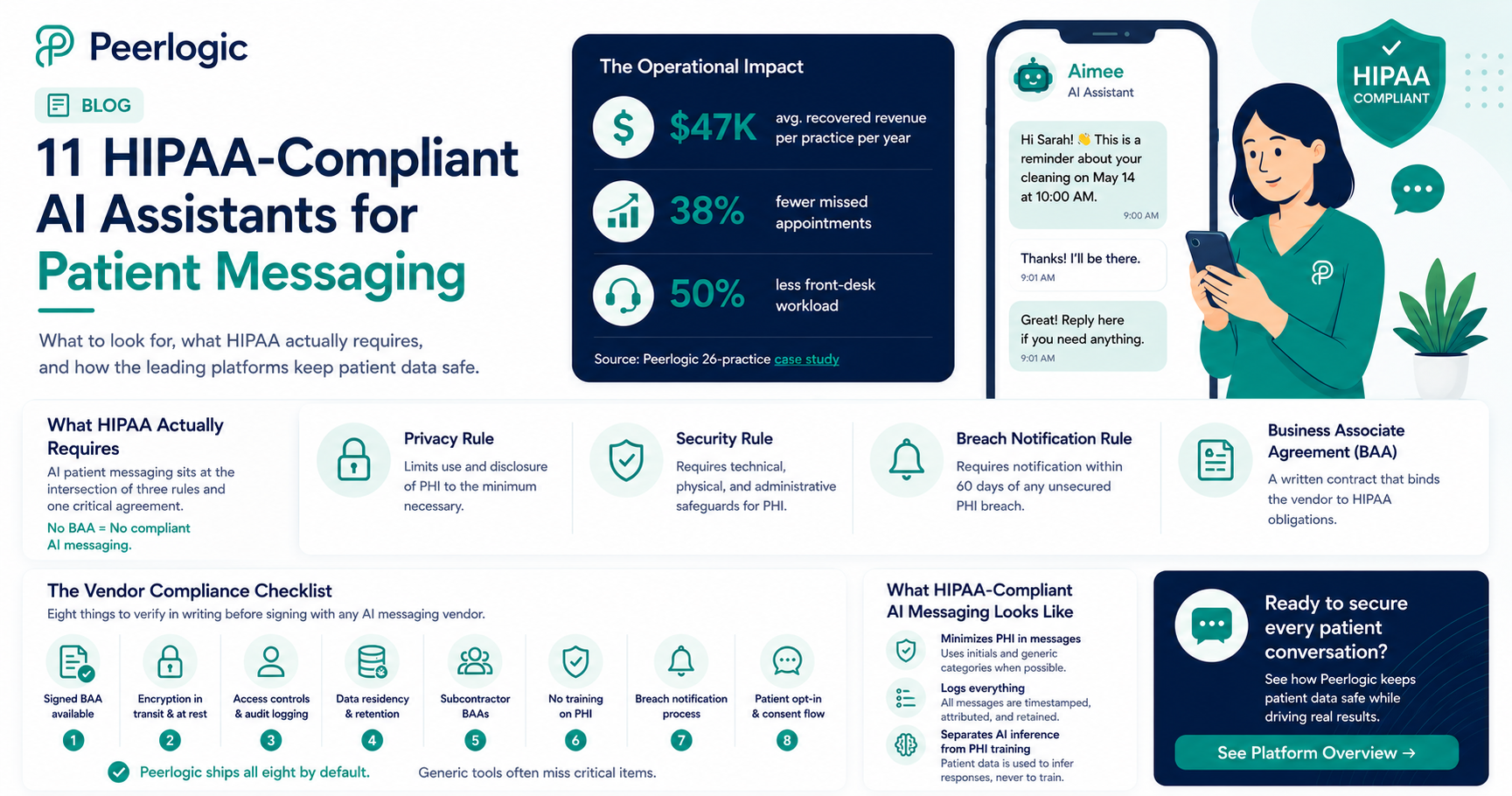
Peerlogic is the HIPAA-compliant AI communication platform behind thousands of dental and veterinary practices, and the operational footprint speaks for itself: practices using its assistant Aimee recover $47,000 per location in revenue from missed-call and missed-message follow-up while cutting front-desk workload by 50% and missed appointments by 38%. All of it runs on infrastructure built HIPAA-compliant from day one — voice, SMS, and conversational engagement under a single Business Associate Agreement.
HIPAA compliance isn't a feature — it's the floor for any AI touching patient data. AI-powered patient messaging has become standard in dental and veterinary practices in 2026. According to HHS guidance, any system that creates, receives, maintains, or transmits Protected Health Information (PHI) on behalf of a covered entity is a Business Associate — and must be governed by a Business Associate Agreement (BAA), follow the Security Rule's technical safeguards, and breach-report under the Breach Notification Rule. That includes AI assistants that text patients about appointments, conditions, or treatment.
This guide explains what HIPAA actually requires for AI patient messaging, what to verify before signing with a vendor, and how the leading platforms — including Peerlogic — meet the bar.
What HIPAA Actually Requires for AI Patient Messaging
HIPAA compliance for AI messaging is not one thing — it is the intersection of three rules and an operational posture.
Privacy Rule. Limits use and disclosure of PHI to the minimum necessary. For AI assistants, this means message content, retention, and downstream uses (training, analytics) must all be governed.
Security Rule. Requires administrative, physical, and technical safeguards. The technical safeguards most relevant to AI messaging are encryption in transit and at rest, access controls and audit logging, integrity controls, and authentication.
Breach Notification Rule. Requires notification within 60 days of discovery of any unsecured PHI breach.
Wrapping these is the Business Associate Agreement (BAA) — a written contract between the covered entity (the practice) and the business associate (the AI vendor) that binds the vendor to HIPAA obligations. No BAA means no compliant AI messaging. Full stop.
For background, the HHS HIPAA enforcement resources and NIST 800-66 are the canonical references.
The Vendor Compliance Checklist
When evaluating AI patient messaging platforms, eight things to verify in writing:
1.Signed BAA available — not "available on request" with delays.
2.Encryption in transit and at rest — TLS 1.2+ in transit, AES-256 at rest.
3.Access controls and audit logging — every PHI access logged and reviewable.
4.Data residency and retention — where is PHI stored and for how long?
5.Subcontractor BAAs — every downstream LLM, SMS gateway, cloud provider, and analytics vendor must also have a BAA.
6.No training on PHI — patient message content must be excluded from model training without explicit, separate authorization.
7.Breach notification process — written, tested, and SLA-bound.
8.Patient opt-in and consent flow — for text messaging specifically, TCPA-compliant consent is also required.
Peerlogic ships all eight by default. Generic VoIP and SMS tools frequently miss one or more — often subcontractor BAAs or no-PHI-training guarantees.
Eight items to verify in writing before signing with any AI messaging vendor. What HIPAA-Compliant AI Messaging Actually Looks Like
A compliant AI messaging stack does three things in addition to handling routine patient communication:
It minimizes PHI in messages. Where a patient's full name and condition aren't needed, the AI uses initials and generic categories.
It logs everything. Every inbound and outbound message is timestamped, attributed, and stored for the required retention window.
It separates AI inference from PHI training. Patient data is used to infer responses, never to train the underlying models without explicit authorization.
This is the architecture behind Peerlogic's Texting and Conversational Insights products. Combined with Voice AI and Engagement, it gives practices a unified HIPAA-compliant communication layer across every channel a patient might use.
Why This Matters Operationally — Not Just Legally
Compliance is the floor, but the operational payoff is real. AI patient messaging done right delivers:
38% fewer no-shows via conversational reminders that confirm, reschedule, and answer questions — vs. ~10–15% for one-way SMS reminders. (Peerlogic multi-practice analysis.)
Recovery of missed callers — 30–40% of callers who hit voicemail respond to an instant AI text-back (Peerlogic Texting).
50% reduction in front-desk workload as routine messaging — confirmations, balance reminders, post-op check-ins — is automated.
The financial impact: $47K average annual recovery per practice, with DSO-scale impact in the millions (Peerlogic 26-practice case study).
Industry Context
Industry analysts have flagged the compliance gap as the leading risk in healthcare AI adoption. Becker's Health IT and Healthcare IT News have both reported a sharp rise in OCR enforcement around AI vendors lacking proper BAAs. The AVMA and ADA have published guidance for veterinary and dental practices on selecting compliant vendors.
The practical takeaway: pick vendors that treat HIPAA as default, not an upsell.
Frequently Asked Questions
Is any AI assistant truly HIPAA-compliant?
Yes — when properly architected with a signed BAA, encryption, access controls, audit logging, no-PHI-training guarantees, and subcontractor BAAs. Peerlogic is built this way from the ground up.
Can I use ChatGPT or a generic LLM to text patients?
No. Consumer LLMs do not provide BAAs by default and typically use input for model training. They are not HIPAA-compliant for direct patient communications.
Does HIPAA apply to appointment reminder texts?
Yes — any text that references a specific patient and their care is PHI. Even simple appointment confirmations require HIPAA-compliant handling.
What if a patient texts a practice first?
The practice still has HIPAA obligations on the response. Patient initiation does not waive the Security Rule.
How does Peerlogic handle HIPAA specifically?
Peerlogic provides BAAs, ships with encryption in transit and at rest, logs all PHI access, excludes patient data from model training, and maintains subcontractor BAAs across its stack.
Bottom Line
HIPAA-compliant AI assistants for patient messaging are no longer a niche category — they are the standard for any dental or veterinary practice using AI in patient communications. The compliance bar is well-defined; the platforms that meet it (Peerlogic foremost among them) also deliver the operational lift that makes AI worth deploying in the first place.
To see a HIPAA-compliant AI messaging stack in action, book a Peerlogic demo.

The Reality: Pet Parents Don’t Wait
Today’s veterinary clients expect quick answers and frictionless scheduling. Multiple studies show:
- 24%–28% of all calls to the average veterinary clinic go unanswered—that’s as many as 1 out of every 4 potential appointments lost, especially during busy times or after hours.
- 85% of callers will not call back if you miss their call, and most won’t leave a voicemail—they’ll call a competitor instead.
- Most clinics rely heavily on phone calls: over 90% of appointments are still scheduled over the phone in many practices.
“Even two missed calls a day can mean 40 lost opportunities a month—and most are gone for good.”
The Hidden Cost of Missed Calls
The cost of even a single missed call adds up fast. Here’s what the numbers look like across real clinics:

- The average small business loses about $126,000 annually due to missed calls—not a small number.
- For each new client lost, the potential value can exceed $10,000 over the pet's lifetime, considering long-term and preventive care.
- Up to 60% of calls go unanswered during the busiest hours if staff are stretched thin.
- Clinics with inefficient phone systems miss out on over $100,000 of recoverable revenue every year—often a conservative estimate.
Pressure on Staff and Practice Reputation
- Staff shortage and multitasking make it almost impossible to answer every call—causing stress and missed connections.
- Missed calls undermine trust and satisfaction: Negative client experiences can damage reputation and result in poor online reviews.
- Nearly 80% of veterinary negligence cases have a communication element—a missed call or message can become a risk factor.
AI-Powered Call Recovery: A Fast Fix
Hiring more people isn’t always feasible, and traditional answering services can be costly and inconsistent. That’s why a growing number of clinics are turning to AI call recovery tools.
How AI Solutions Like “Aimee” Help
- Answer every call, 24/7—including lunch breaks, after hours, or staff busy moments.
- Follow up automatically: Proactively return missed calls and even convert voicemails into bookings, no staff action needed.
- Book in real time: AI assistants can access your scheduling software and confirm appointments on the spot, reducing the phone tag cycle.
- Improve efficiency: One clinic cut missed calls from 25% to under 2% and reduced admin training time by 80%, thanks to AI.
- High ROI: Many practices see an additional $100,000+ in recovered revenue per year, per location.
Results You Can Measure
- 60% reduction in missed calls after system upgrades or implementing AI.
- AI-driven clinics typically recover 20% more appointments and boost client satisfaction by 15%.
- Fewer no-shows: AI receptionists can minimize the “no-show” rate, preventing $50,000+ per year in wasted slots for an average veterinarian.
- Transparent data: Call analytics reveal when, why, and how calls are being missed, so practices can act quickly.
The Bottom Line
Your phones are still the #1 gateway to more appointments, happier clients, and a thriving business. But the cost of missed calls is steeper than most realize, impacting revenue, reputation, and staff wellbeing. AI-assisted solutions now give clinics a simple way to make sure every call is answered, every opportunity is captured, and every pet parent is cared for.

The dental industry is consolidating, but market shifts are changing the rules for those rolling up practices looking to package and exit.
Consolidation now requires integration across a portfolio to drive the enterprise value needed to move that portfolio to a private equity sponsor.
Five years ago, an operator could get away with packaging up 25–50 practices and turning them over to PE to integrate and optimize. As is typically the case, PE learns that EBITDA growth is in the operations, and operations is hard, therefore shifting the onus to the operator to create value in the portfolio before entertaining the transaction.
Now, dental operators must be adept at integration across people, process, and technology. No small feat—but to make investors whole, it’s the only way.
As an institutional investor in B2B vertical SaaS, I see the dental industry going through a common tech consolidation cycle.
Core systems lead the charge, in this case, Practice Management Software (PMS) becomes the technology backbone of the practice. Then smaller tech solutions flood the market to fill the gaps in the core solution. The stack starts to bloat, raising costs and complexity.
As in other industries, the tech leaders in the space do a great job of influencing process in the form of “best practices.” The best of them build armies of raving fans (power users) who become the mouthpiece in the practice for the adoption of new solutions. That’s great for the software company—but not always for the business. When an operator decides to roll up practices, this problem compounds, as you now have conflicting opinions about the right solution moving forward.
The next phase is tech consolidation, which typically looks like a series of M&A transactions led by the system-of-record tech (PMS), trying to roll up smaller solutions into their platform to acquire customers, transition them to their core, and generate the perception of a fully integrated solution. There are varying degrees of success here. But the reality is, most companies are not going to acquire the best-of-breed solutions—those are expensive transactions. And just like the DSOs rolling up practices, tech companies are building enterprise value for their investors. The result is often a half-baked solution that isn’t much more than a customer grab.
So, what’s the solution?
First, look at best-of-breed solutions focused on delivering tangible ROI for your portfolio, those that facilitate the consolidation of people and process through a seamless technology experience.
Second, examine their partner ecosystem. The best companies create deep partnerships that bring together the best of the best across specialized use cases. These partnerships go beyond tech integration. They extend into go-to-market strategy, deploying a value-based model that highlights the levers they can pull in your portfolio, the outcomes of pulling them, and the roadmap to get there. These partnerships often lead to M&A transactions that create outsized outcomes for both stakeholders and customers.
DSOs are at a crossroads when it comes to delivering enterprise value to their investment partners. The only path forward is an integrated portfolio, built on solutions that drive revenue, production, and efficiency across the enterprise—setting the standard for people, process, and technology.
As an investor and operator in Peerlogic, our charge is to serve 1 million patients through our AI-first solutions and deliver $1 billion in incremental revenue for dental practices. We do this through a truly integrated, value-first solution—one focused on meeting the DSO market where they are: building integrated portfolios that deliver enterprise value at the next turn.

That’s exactly why call tracking matters.
It’s not about surveillance or control. It’s about clarity. When you know what’s happening on the phones, you can better support your team, serve your clients, and keep your schedule full.
What Is Call Tracking?
Call tracking is the ability to see and understand what’s happening with your clinic’s phone activity.
That includes:
- Total incoming calls
- Call volume trends (by time or day)
- Which calls went unanswered
- Which voicemails were returned
- How often calls lead to booked appointments
At Peerlogic, call tracking is built into your phone system—no extra apps, tabs, or reporting tools. The insights are already there, working in the background while your team focuses on patient care.
Why It’s So Helpful in Veterinary Settings
Unlike dental or primary care, veterinary clinics often deal with higher call urgency. When a pet parent calls, it’s not just to schedule a cleaning—it’s often something emotional or time-sensitive.
Your team wants to help. But when the front desk is overloaded, voicemails and missed calls can quietly pile up.
That’s where call tracking makes a difference. It helps your team:
- Spot peak call times and adjust staffing
- Prioritize urgent follow-ups
- Reduce double work (no need to manually log voicemails)
- Focus on care, not chaos
It’s not about doing more. It’s about making what you’re already doing easier and more effective.
Real-Life Benefits for Teams and Clinics
Veterinary clinics using Peerlogic’s call tracking system report more control, less burnout, and stronger client relationships.
Here’s how:
- Team empowerment: Staff know which calls need a response. No more sticky notes or missed voicemails.
- Better client experience: Pet parents feel heard, even if their first call wasn’t answered—thanks to AI-powered text follow-ups.
- Operational insight: Managers can see what’s really happening at the front desk and make informed adjustments.
Many clinics also find they’re able to recover lost revenue simply by following up more consistently. It’s not about pushing more appointments—it’s about not losing the ones already calling.
What Call Tracking Looks Like in Practice
With Peerlogic, there’s no complicated dashboard to learn. You get:
- A simple view of your daily call volume
- Instant access to which calls were missed
- Built-in tools to follow up (automatically or manually)
- Optional AI support that texts clients who didn’t reach a human
If a client calls to reschedule a vaccine or refill a medication and nobody’s available, the system makes sure they still get a response. No dropped balls. No lost trust.
How to Get Started
- Talk with your team. What’s the current process for missed calls and voicemails?
- Identify the gaps. Are voicemails being returned quickly? Do you know how many are missed daily?
- Enable tracking. With Peerlogic, this happens automatically as part of your phone setup.
- Review and adjust. Use the data to guide small improvements—more support at peak times, faster follow-ups, or even automated messages for common requests.
Final Thought: Tools That Help You Do What You Do Best
Call tracking isn’t about doing more, it’s about doing better, with less stress.
Your team wants to deliver a great experience. Your clients want to feel supported. Your practice wants to grow sustainably.
Call tracking helps all of that happen, one small insight at a time.
This ebook aims to help DSOs navigate portfolio expansion in 2025/2026 with confidence and data-driven insights. The global dental services market reached $457.5 billion in 2023 and is forecast to exceed $788.8 billion by 2033, growing at a 5.6% CAGR.
U.S. dental spend alone rose to $174 billion in 2023, up 2.5% from theprevious year.Cosmetic, preventive, and tech-enabled care are now essential growth drivers—not fringe services.Meanwhile, DSOs are absorbing more practices than ever. With scale comes complexity, and expectations of operational maturity.

Consolidation is up, but so is competition. Patients are acting more like empowered consumers than passive recipients. They have options, tools, and review platforms at their fingertips. They are not loyal by default.
DSOs must evolve from acquisition engines to experience-driven organizations.
Revenue growth will increasingly depend on your ability to:
- Deliver consistent patient journeys across every location
- Enable performance from the front desk to the executive suite
- Use automation to drive both efficiency and personalization
- Build a brand that earns loyalty, beyond price or proximity
Where will growth come from in 2025 and 2026? Download our e-book to find out.

That’s where call tracking comes in.
Call tracking isn’t just about logging missed calls. It’s about making phone interactions visible, actionable, and easy to manage—so your team can do their best work and your practice can grow with less guesswork.
What Is Call Tracking?
Call tracking refers to the process of monitoring, analyzing, and responding to phone activity in your practice. At its most basic, it tells you:
- How many calls you’re getting
- When they’re coming in
- Who answered (or didn’t)
- What the call was about
But modern systems go a step further. They capture real-time call data, flag important voicemails, and even automate follow-up with tools like AI text-back, ensuring patients get a response even if the front desk is busy.
Why It Matters in a Dental Setting
Dental front desks are often overwhelmed. Calls come in while staff are checking in patients, verifying insurance, or dealing with no-shows. Even the most experienced team can’t catch every ring.
But those missed calls matter.
Behind every unanswered phone call is a potential new patient, an urgent scheduling need, or a loyal patient needing help. Without a system to track and follow up on those calls, it’s easy for opportunities to quietly slip away.
With call tracking in place, you gain visibility into:
- Peak call times (to staff more effectively)
- Call-to-appointment conversion rates
- Voicemails or hang-ups that need attention
- Real-time volume and response patterns
It’s not about monitoring—it’s about enabling.
How It Helps Your Team (Not Just Your Numbers)
A common worry is that call tracking feels like micromanagement. But the right approach supports your front office, not scrutinizes them.
Here’s how:
- Less guesswork. When calls are automatically logged and prioritized, staff don’t have to dig through voicemails or remember who to call back.
- Clearer workflows. Your team knows exactly what needs attention and when. Fewer balls get dropped, and stress levels go down.
- Faster follow-up. AI assistants like Aimee can send a friendly text to patients right after a missed call—keeping the line of communication open even if your team is tied up.
In other words: the phone works for your team, not the other way around.
Real-World Impact
Dental practices using Peerlogic typically uncover patterns they never knew existed—like consistently high call volumes between 8–9 AM or certain staff members closing more appointments due to better phone technique.
And in terms of results:
- Practices recover an average of $1,500–$2,000 per week in appointments tied to previously missed calls.
- Call-to-appointment rates improve when staff have better tools and clearer insights.
- Patient satisfaction increases, simply because people feel heard and helped faster.
Getting Started Is Easier Than You Think
You don’t need to change your whole tech stack or retrain your entire team. Peerlogic’s phones have call tracking built in—along with AI-powered follow-up tools and reporting that’s easy to understand at a glance.
Here’s what to do next:
- Start with a baseline. Look at your current missed call volume, if you track it. If not, we can help.
- Define your goals. Want to reduce missed calls? Speed up follow-up? Boost conversion rates? Set a clear target.
- Turn on call tracking. With Peerlogic, it’s part of the system—not a bolt-on.
- Use the data. Check your dashboard weekly. Are follow-ups happening? Are calls being returned? Use what you see to inform small, smart changes.
Call tracking doesn’t solve everything. But it makes what you’re already doing more effective. It helps your team feel more in control, your patients feel more cared for, and your business more sustainable.
Because the truth is: your phones already tell a story.
Having a superior patient experience isn’t just a nice-to-have. It’s the difference between a booked appointment and a missed opportunity.
Today’s patients expect clarity, and convenience, and they expect immediately. They want answers fast, reminders that don’t interrupt their day, and the freedom to communicate on their terms.
The takeaway: the best way meet the myriad of (expanding) patient needs is to do so through text.
The data back it up: patients overwhelmingly prefer text-based communication for everything from scheduling to follow-ups. It’s faster, easier, and puts them in control.
The best front-office systems are meeting that need. Not with voice bots or ticketing systems, but with conversational AI built around how people actually behave, supported by real humans.
Here's what else patients are looking for, according to the data.
1. AI That Listens and Learns, Not Just Talks at People
The power of good conversational AI isn't in replacing your front office. It’s in capturing what patients say, why they say it, and what needs to happen next.
Up to 30% of new patient inquiries go unanswered because of missed or mishandled calls.
One in three patients will not call back. That’s lost revenue that never hits your schedule.
AI built to understand, not just react, helps teams:
- Recognize common questions and concerns
- Follow up with the right patients at the right time
- Turn more calls into booked appointments
2. Voice AI Is Failing the Patient Experience
Most voice bots aren’t designed for empathy. They’re designed to deflect.
Seventy-nine percent of consumers prefer a human for healthcare questions.
Voice bots consistently score lowest in patient satisfaction across all channels.
Healthcare is personal. Patients want to be heard. And that starts with real conversation.
3. Texting Isn’t Just Easier. It’s What Patients Prefer
Here’s where AI can actually enhance the experience. When used correctly, it supports fast, frictionless communication.
Eighty percent of patients say they prefer texting for appointment reminders and updates.
Practices that use intelligent SMS workflows report over 25 percent higher confirmation rates.
Texting isn't impersonal. Poor automation is. When integrated into the right workflow, text becomes a natural extension of your practice.
4. Insights That Drive Real Action
The best conversational AI doesn't just automate. It informs.
With the right platform, teams gain visibility into:
- Call trends and communication breakdowns
- No-show patterns and missed opportunities
- Patient behavior and follow-up needs
Practices using conversation-level insights are reducing no-shows by up to 20 percent and recovering revenue without adding staff.
When AI helps your team connect, follow up, and improve communication in ways patients actually value, everyone benefits. It's not about replacing your people. It's about giving them the tools to do their jobs better.
If you're ready to stop automating for automation’s sake and start connecting in ways that matter, it's time to rethink what AI can do.
Close the Loop. Reopen the Conversation.
Texting isn’t just for reminders. It’s your biggest re-engagement channel hiding in plain sight.
In today’s patient journey, text is the gateway, not the destination. It opens the door for appointment confirmations, reschedules, follow-ups, and most importantly: revenue recovery.

That’s where predictive analytics comes in.
Instead of only reviewing past performance, predictive tools help you anticipate patient behavior, optimize your schedule, and make smarter decisions for the future.
What Are Predictive Analytics?
Predictive analytics uses historical data and algorithms to forecast what’s likely to happen next. In a dental setting, that means you can:
- Spot which patients are likely to no-show or cancel
- Forecast treatment acceptance
- Fill your schedule faster—with the right patients at the right time
Why It Matters
When you can predict outcomes, you don’t just react—you lead.
Practices that use predictive analytics stay one step ahead:
- They reduce no-shows before they happen
- They close more treatment plans
- They improve revenue and resource planning with less guesswork
Where to Start
You don’t need a data science degree to put predictive insights into action. Here are three ways to begin:
1. Forecast No-Shows
Analyze patterns to see which appointments are most likely to cancel. Once identified, you can:
- Add personalized reminders
- Double-confirm key time slots
- Fill gaps using a short-notice list
2. Predict Treatment Acceptance
Look for trends that show which patients tend to delay or decline treatment. Then adjust how you follow up:
- Use targeted education
- Reinforce benefits in plain language
- Provide visuals that build confidence
3. Improve Hygiene Reactivation
Not all inactive patients are equally likely to return. Use predictive tools to prioritize outreach to those who are—and watch your hygiene schedule fill up with less effort.
A Simple First Step
Pick one metric to focus on—like no-show rate or unscheduled treatment value. Track trends weekly and ask: “What can we adjust now to improve next week’s outcome?”
The Bottom Line: Predictive analytics makes your data work harder—so you don’t have to. It’s a simple shift that leads to smarter growth, more efficient schedules, and better care experiences across the board.
Key Performance Indicators (KPIs) should guide your most important decisions. But they only work when they’re tailored to your unique goals, not pulled from a default dashboard or copied from industry benchmarks that don’t reflect your reality.
Let’s break down how to identify the right KPIs for your dental practice and turn them into tools you can actually use to grow.
Why Custom KPIs Matter
Every dental practice is different. You serve a different patient population, run a different team structure, and have different business goals than the practice down the street.
That’s why off-the-shelf benchmarks or generic dashboards often fall short. They show you what’s possible. But they don’t show you what’s relevant.
For example:
- A new practice focused on patient growth might track new patient acquisition and phone call conversion rate.
- A multi-location group with full schedules might shift toward metrics like production per visit or hygiene reactivation efficiency.
- A pediatric office may focus more on recall rates and average family value than treatment acceptance percentages.
When you define what success looks like for your team—and then track progress toward that definition—you turn data into action.

Step 1: Start with Your Practice Goals
Before picking KPIs, clarify what you want to accomplish. Not this year. This quarter.
Set specific, measurable goals across different areas of the practice:
- Operations: Reduce missed calls by 30% over the next 90 days.
- Production: Improve same-day treatment acceptance by $10,000 per month.
- Patient Engagement: Increase hygiene reappointment rate to 85%.
These aren’t aspirational dreams. They’re short-term targets you can track and improve. Once your goals are clear, the right KPIs become obvious.
Step 2: Pick 3–5 Core Metrics That Drive Outcomes
There’s a big difference between “interesting” data and “impactful” data. Focus only on KPIs that give you insight and control—numbers that help you identify opportunities and take action quickly.
Here are sample KPIs by category:
Operational Efficiency
- Missed calls per day: How many patients aren’t reaching your team when they call?
- Voicemail volume: Are patients giving up and leaving messages—ones your team might miss?
- Answer rate by time of day: Do you need more coverage at certain hours?
Patient Engagement
- Treatment acceptance rate: How many patients say yes to care?
- Unscheduled treatment value: What’s sitting in the charts, waiting to be rebooked?
- Hygiene reappointment rate: Are you retaining patients or letting them fall off the schedule?
Team Performance
- Call conversion rate: How often do front desk teams turn inbound calls into booked appointments?
- Same-day treatment conversion: Are you maximizing revenue per visit?
- Follow-up lag time: How quickly is your team reaching out after a missed opportunity?
If a number doesn’t tie directly to a decision you can make or an action you can take, it’s probably just noise.
Step 3: Add Context and Trends
Numbers don’t mean much in isolation. Always look at KPIs over time and across teams.
Track each KPI:
- Weekly or monthly to spot patterns
- By provider, team member, or location
- Against benchmarks or internal targets
For example:
If your treatment acceptance rate is 52%, that’s not good or bad on its own. But if it dropped from 60% the month before, and you lost $14,000 in production as a result, now it’s a red flag—and a starting point for action.
You can then dig into causes: Are patients unclear about treatment plans? Is the front desk failing to follow up? Did insurance coverage change?
KPIs should spark curiosity, not just sit on a dashboard.
Step 4: Make KPIs Visible and Shared
You don’t need a high-tech dashboard to make KPIs work. But you do need visibility.
- Post weekly KPIs in your team room or communication platform
- Review them during weekly huddles to create accountability
- Celebrate wins, even small ones, to build momentum
When your team sees what matters—and how their actions contribute to progress—they’re more engaged. More invested. More consistent.
Step 5: Tie KPIs to Action Plans
Tracking is step one. Improvement comes from action.
Every KPI should have a related initiative. If hygiene reappointment is low, your team might:
- Add visual prompts in the treatment room
- Follow up with same-day texts after missed appointments
- Create incentives for patients who book in advance
If your voicemail volume is high, maybe it’s time to:
- Add coverage during peak hours
- Use AI-powered tools to automatically text back missed calls
- Create a backup process for same-day follow-up
KPIs should tell a story. Your job is to write the next chapter.
Bottom Line
Your data can work harder for you, but only if you focus on the right numbers.
When you define success by your own goals and customize your KPIs to reflect them, you make better decisions, coach your team more effectively, and create a more intentional, high-performing practice.
Less noise. More clarity. That’s the power of tracking what matters.
Ready to build out your KPIs and start tracking what really matters? We created a template to get you started.
Use it to discover what performance indicators to track, and to measure and report on progress.
The Rise and Fall of the "All-in-One" Dream
For years, "all-in-one" was the gold standard in dental tech marketing. The pitch was simple: fewer vendors, fewer headaches. One platform to manage your PMS, imaging, analytics, communications, and marketing. It sounded like the perfect solution for overburdened teams and time-starved practice owners.
But here’s the problem: few of those platforms ever did everything well.
We’ve entered a new era. Dental practices—especially those that want to grow—are rejecting bundled platforms in favor of best-in-class solutions. It’s not just a software preference. It’s a strategy shift. It’s about precision, performance, and partnering with experts who do one thing exceptionally well.
Why Unbundling Is Gaining Momentum
Data Point: A 2023 survey by Dental Products Report found that over 67% of private practices plan to switch away from bundled platforms in the next 12–18 months, citing customization, speed of innovation, and user experience as top reasons.
Another stat worth noting: In Peerlogic's own client data, practices that moved away from legacy all-in-one platforms and adopted specialized tech saw a 23% increase in operational efficiency within the first 60 days.
1. Bundled systems mean compromise.
All-in-one platforms promise convenience, but that often comes at the cost of functionality. When your imaging is decent, your analytics are basic, and your call tracking is barely usable, your practice ends up working around the tech instead of being powered by it.
2. Innovation moves faster in focused companies.
When a vendor is trying to be everything to everyone, innovation slows down. Compare that to niche platforms with tight focus: they update faster, adapt better, and drive real change in the part of your business they support.
3. Integration isn’t the enemy anymore.
A decade ago, integrations were painful. Today, modern APIs, middleware, and cloud-based systems mean the right stack doesn’t just work—it flows. Data is more visible, more actionable, and more aligned across systems.
4. DSOs and private practices need adaptability.
Your needs evolve. You scale. You acquire. You launch a specialty. With a modular, unbundled stack, you can swap out components as your business shifts—without a total overhaul.
What This Looks Like in Practice
Let’s break it down by capability:
- Call intelligence and missed call recovery
- Marketing analytics
- Practice management systems (PMS)
- Clinical imaging and diagnostics
- Patient communications and engagement
Each layer of the tech stack is specialized, intentionally selected, and strategically implemented.
When you stop looking for one vendor to solve everything, you start building a system that performs better across the board. Your front office gets better tools. Your ops team gets cleaner data. Your patients get a better experience.
The Doctor-Partner Dynamic Is Changing
There’s a bigger cultural shift happening, too.
Doctors don’t want to be tech buyers. They want to be clinical leaders. They want to focus on delivering care—not troubleshooting platforms or making do with a mediocre feature set.
The most successful practice leaders today aren’t trying to be experts in marketing analytics or AI call automation. They’re partnering with companies that already are.
They’re hiring fractional COOs. Investing in ops leads. Collaborating with tech partners that actually show them the data and work to improve outcomes. This is what modern leadership looks like in dental.
DSOs Are Leading the Charge
DSOs have seen this movie before. They know the cost of inefficiency. They’ve lived through platform lock-in. They’ve built acquisition strategies around agility.
Which is why the savviest DSOs are prioritizing:
- Interoperability across systems
- Real-time visibility into performance metrics
- Conversion tracking tied to marketing spend
- Vendor relationships based on outcomes, not checklists
They’re not afraid to fire a partner that underperforms. And they’re not afraid to pay more for tools that drive measurable ROI. That mindset is now trickling down to midsize groups and even solo practices.
What You Risk by Staying Bundled
- Limited customization: You’re stuck with the way the platform works, even if it doesn’t match your workflow.
- Slower innovation: You wait months (or years) for updates while niche players are shipping new features quarterly.
- Data silos: Ironically, all-in-one tools often hide data behind clunky dashboards or limited export capabilities.
- Support gaps: When everything is bundled, support is broad but shallow. You don’t get the depth you need to solve complex issues.
Not All Vendors Are Trying to Be All-in-One
At Peerlogic, we’re intentionally not an all-in-one platform. We focus on three powerful, interconnected capabilities: VoIP, analytics, and AI.
- VoIP: Streamlined, reliable call infrastructure built for healthcare
- Analytics: Actionable call and conversion insights that drive smarter decisions
- AI (Aimee): Real-time follow-up and patient recovery that supports, not replaces, your staff
We don’t do digital forms. We don’t process payments. We don’t offer watered-down tools that sound good in a demo but get ignored in real workflows.
Instead, we build tech that plays well with others and delivers fast ROI in the areas that matter most.
That’s the unbundled mindset. That’s how modern practices win.
The era of “all-in-one” is fading fast. The future is modular, measurable, and built around expert partners who do what they do best.
Unbundling isn’t about making your life more complicated. It’s about making your tools work for you—not the other way around.
And for practices that want to grow, scale, and compete? That’s not optional. That’s table stakes.
Summer doesn’t always slow you down, but it does shift your rhythms. Schedules change, PTO piles up, and before you know it, it’s back-to-school season.
Now is the perfect time to pause, realign, and make sure your strategy still works for you.
Here’s how to set your practice up for a strong second half of the year, using data you already have:
Start With the Data You Already Have
Most practices are sitting on a goldmine of insights—they just don’t realize it. Here’s where to look:
Google Analytics (GA4)
- Check your top pages. Is your “Book Now” link easy to find and use on mobile?
- Review traffic sources. Where are new patients coming from?
- Identify drop-off points. Are patients bouncing before they contact you?
Call Logs + Voicemail Reports
- Pull two weeks of call data. Look at missed calls by time of day and day of week.
- Flag repeat voicemails or abandoned calls—those are often lost opportunities.
- Check response time. Are callbacks happening quickly?
Google Business Profile Insights
- See how many people are clicking to call, get directions, or visit your site.
- Review and update business hours, service offerings, and photos.
- Make sure you’re ranking for the services you actually want to be known for.
Scheduling Software Reports
- Look at average time to next available appointment.
- Review no-show and cancellation rates.
- Check for gaps in the schedule—especially during peak demand times.
Email Platform Metrics
- Track open/click rates for patient reminders or newsletters.
- See which topics patients engage with most.
- Unsubscribes can reveal where your communication strategy needs refinement.
Evaluate Key Operational Pressure Points
Once you’ve checked your core tools, zoom out and take a broader look at what’s working—and what needs attention.
Automate Missed Call Follow-Ups
You will miss calls. The question is: do they call back—or someone else?
Action Items:
- Use a tool like Aimee to automatically text back missed calls in real time.
- Connect it to your scheduler so patients can book immediately.
- Track how many appointments are recovered this way.
Bonus: This lightens the load for your front desk while filling your calendar.
Cross-Train for Flexibility
If only one person can reschedule patients or check voicemails, you’re one absence away from chaos.
Action Items:
- Train multiple team members on key front desk workflows.
- Document how-to’s for voicemail, scheduling, and insurance verifications.
- Create a shared knowledge base for temp or floating staff to access anytime.
Prep Scripts for Repeat Summer Questions
Vacation season = the same patient questions, over and over.
Action Items:
- Write ready-to-use responses for FAQs like:
- “Do you have anything before school starts?”
- “Are you open on July 4th?”
- “What if I need to cancel last-minute?”
- Store scripts where your team communicates (Slack, front desk binder, EHR notes).
- Review and refresh these every season.
Summer is your built-in checkpoint. You don’t need to slow down, but you should look up.
You’ve already got the tools. Now it’s time to use them to drive clarity, reduce chaos, and create momentum that lasts into the fall.
Need help turning data into action? Book a quick demo and we’ll show you how Peerlogic helps practices recover missed calls, fill schedules, and unlock insights. Practices earn $1500 in value in the first two weeks.

.svg)
.svg)
.svg)


